
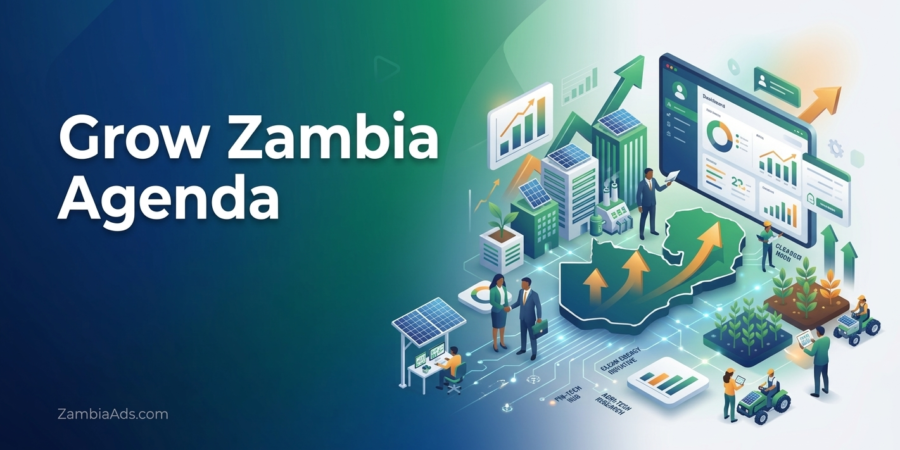
Zambia’s Grow Zambia Agenda represents an important shift in the country’s economic ambitions: moving from economic stabilisation towards faster growth, higher production, job creation and greater participation in the economy.
But what does the agenda actually mean for ordinary Zambians? How could it affect farmers, young people, teachers, entrepreneurs, workers and businesses? And what must happen for ambitious national production targets to translate into better living standards?
These are the questions that matter. Announcing targets is one step; building the productive capacity, infrastructure, markets and institutions needed to achieve them is another.
This article examines the Grow Zambia Agenda, its main targets, its potential opportunities and its implementation challenges. It distinguishes between the government’s stated ambitions and outcomes that have yet to be achieved.
Table of Contents
1. What Is the Grow Zambia Agenda?
The Grow Zambia Agenda is a national economic development programme unveiled by President Hakainde Hichilema during his second-term inauguration in September 2026. Its stated purpose is to move Zambia from economic stabilisation towards accelerated growth by expanding production, attracting investment, creating jobs, strengthening entrepreneurship and increasing economic opportunities.
Its headline ambitions include producing 10 million tonnes of maize, generating 10,000 megawatts of electricity, attracting five million tourists annually, producing three million tonnes each of copper and soya beans, producing one million tonnes each of wheat and sugar, and building a beef industry generating US$1 billion in export earnings. These are targets, not achieved results.
2. Why Was the Grow Zambia Agenda Introduced?
To understand the agenda, it helps to understand the economic challenge it is intended to address.
Zambia has significant economic assets, including copper resources, agricultural land, tourism attractions, a young population and opportunities in energy and manufacturing. However, having economic resources does not automatically translate into broad prosperity.
A country may export valuable minerals while many households struggle with the cost of living. Farmers may produce crops but lack reliable markets, affordable transport or sufficient storage. Young people may complete their education but struggle to find suitable employment. Small businesses may have promising products but lack electricity, finance, equipment or access to larger markets.
These examples illustrate a fundamental economic distinction: possessing resources is not the same as developing the capacity to turn those resources into widely shared prosperity.
The Grow Zambia Agenda seeks to address this challenge by placing greater emphasis on production and economic expansion.
From stabilisation to growth
The government’s stated direction is a transition from stabilising the economy to accelerating growth. The September 2026 announcement identified production targets as a central part of this transition.
Economic stabilisation and economic growth are related, but they are not identical.
- Economic stabilisation involves strengthening conditions such as inflation control, fiscal management, exchange-rate stability and public-debt sustainability.
- Economic growth involves increasing the amount of goods and services an economy produces.
- Inclusive growth means ensuring that the benefits of expansion reach households and communities through employment, earnings, improved services and broader economic participation.
A country can improve its macroeconomic indicators without every household immediately experiencing better living conditions. Similarly, economic growth may occur without creating enough decent jobs if it is concentrated in capital-intensive industries.
The challenge for Zambia is to connect economic stability with productive investment, job creation and improved living standards.
3. The Eight Main Targets of the Grow Zambia Agenda
The agenda is popularly summarised through the numerical sequence 10-10-5-3-3-1-1-1. The figures represent eight headline production and economic targets reported at the launch.
10m
1. Produce 10 million tonnes of maize
Sector: Agriculture and food security
The target aims to expand maize production, a crop central to Zambia’s food system and agricultural economy. Achieving it sustainably will require attention to productivity, rainfall risks, irrigation, input costs, storage and reliable markets.
10,000
2. Generate 10,000 megawatts of electricity
Sector: Energy and infrastructure
Greater electricity-generating capacity could support factories, mines, farms, irrigation, tourism and digital services. However, generation capacity alone is insufficient: transmission networks, distribution, affordability and dependable supply also matter.
5m
3. Attract five million tourists annually
Sector: Tourism and hospitality
Zambia could benefit through accommodation, transport, tour operations, food services, cultural experiences and conservation-related activities. Success depends on accessibility, visitor safety, service quality, marketing and the value visitors spend locally.
3m t
4. Increase copper production to three million tonnes
Sector: Mining and industrial development
Copper is important to Zambia’s export earnings and industrial potential. Higher output could create opportunities in mining services, engineering, logistics and processing. The wider benefit depends on investment, operating costs, environmental safeguards and stronger domestic supply chains.
3m t
5. Produce three million tonnes of soya beans
Sector: Agriculture and agro-processing
Soya beans can support livestock feed, food processing and industrial uses. Expanded production could benefit farmers, seed suppliers, transport operators, processors and storage businesses if demand and market access grow alongside supply.
1m t
6. Produce one million tonnes of wheat
Sector: Agriculture and food processing
Increasing domestic wheat production could strengthen local supply chains for flour and related products. The challenge includes irrigation needs, suitable growing conditions, input costs, energy availability and competition from imports.
1m t
7. Produce one million tonnes of sugar
Sector: Agriculture and manufacturing
Higher sugar production could support farming, processing, packaging, distribution and related industries. Sustainable expansion must consider water availability, land use, energy, production costs and demand in domestic and export markets.
$1bn
8. Build a beef industry generating US$1 billion in export earnings
Sector: Livestock and agricultural exports
This ambition points towards a larger, export-oriented livestock value chain. It would require healthy animals, veterinary services, suitable feed, processing facilities, traceability, reliable transport and access to markets that accept Zambian beef.
Source: ZNBC’s reporting on the launch and contemporary coverage of the presidential inauguration. The figures describe government ambitions, not independently verified achievements.
What do these eight targets have in common?
They seek to expand production across connected parts of the economy. Agriculture supplies food and industrial inputs; electricity supports production; mining earns export revenue and creates demand for services; tourism generates spending; and processing can add value to locally produced materials.
The potential is greater when these sectors reinforce one another rather than operate in isolation.
For example, reliable electricity can support a food-processing factory. That factory can buy crops from local farmers, employ technicians, contract transport operators and sell products to retailers. The resulting economic activity may create more opportunities than exporting an unprocessed commodity alone.
That is the broader economic opportunity behind a production-centred development agenda.
Also Watch president HH’s speech in Paliarment on Grow Zambia Agenda
4. What Does the Grow Zambia Agenda Mean for Ordinary Zambians?
National targets can sound distant from everyday life. Their real significance lies in whether they change the opportunities available to people.
For farmers
Farmers may benefit from stronger demand for maize, soya beans, wheat, sugar cane and livestock products.
But an increase in national production does not guarantee higher earnings for every farmer. If supply rises faster than demand, prices may fall. If transport costs are high or buyers are unreliable, farmers may struggle to sell profitably.
Farmers need more than encouragement to produce. They need commercially realistic production plans, appropriate inputs, extension services, storage, transport and dependable buyers.
For young people and job seekers
Growth across agriculture, energy, mining, tourism and manufacturing could create opportunities for people with technical, vocational, digital and business skills.
Examples include:
- Electrical installation, maintenance and renewable-energy services.
- Agricultural technology, irrigation and equipment maintenance.
- Food processing, quality control, packaging and logistics.
- Hospitality, tourism management and customer service.
- Accounting, marketing, software, data analysis and business administration.
- Engineering and specialist services supporting mines and industrial facilities.
However, these are potential opportunities, not a guarantee that jobs will appear automatically.
Young people can respond by investigating the skills employers need in their areas, seeking practical experience, learning relevant technologies and identifying problems that businesses are willing to pay to solve.
For entrepreneurs and small-business owners
The agenda could create demand for goods and services throughout the supply chain.
A small business does not necessarily need to own a mine, a large farm or a power station to participate in economic growth. It might supply protective equipment, maintain machinery, transport agricultural products, provide digital marketing, manufacture packaging or offer bookkeeping services.
The important question is not simply, “Which sector is growing?”
It is also, “Which specific problem in that sector can my business solve reliably and profitably?”
For consumers and households
Higher domestic production could improve food availability, support local industries and reduce dependence on some imports. But these outcomes are not automatic.
Prices also depend on input costs, transport, exchange rates, market competition, taxes, processing capacity and the availability of imported alternatives.
The relevant measure of success is not production volume alone. It is whether production improvements help households access goods, services and employment on better terms.
For rural communities
Agricultural production, livestock, tourism and infrastructure investment could support rural economic activity.
Yet rural development requires more than large national output figures. Communities also need roads, communications, electricity, clean water, health services, education and access to finance.
Growth that leaves rural producers unable to reach markets will struggle to deliver its full potential.
5. The Grow Zambia Agenda and Education: Learning Through Production
One of the most interesting dimensions of the Grow Zambia approach is its connection to education and practical skills.
The Ministry of Education’s official Grow Zambia Production Units platform describes an approach that connects classroom learning with practical production, enterprise and innovation. It emphasises applying knowledge through activities such as agriculture, carpentry, metal fabrication, tailoring, ICT, retail and hospitality. The stated purpose is to complement education, not replace its core teaching mandate.
This is particularly relevant to Zambia’s competence-based curriculum.
Why practical education matters
Imagine two pupils studying agriculture.
The first learns about poultry farming from a textbook. The second studies the same concepts and also participates in a supervised poultry project, recording feed costs, monitoring growth, practising biosecurity and calculating the cost of production.
Both pupils can acquire useful knowledge. The practical project, however, provides additional opportunities to apply concepts, work with others, solve problems and understand how production works.
The same principle applies to Geography, Mathematics, Business Studies, Science, ICT and Design and Technology.
A Geography lesson on agriculture can explore rainfall, soils, irrigation and agricultural markets. A Mathematics lesson can calculate costs, yields and profit margins. A Business Studies lesson can examine pricing, record-keeping and customer demand.
When appropriately planned, these connections make learning more relevant to real economic activities.
What school production units could involve
The Ministry of Education’s platform identifies six thematic areas for production units.
| Thematic area | Illustrative school activity | Skills pupils can develop |
|---|---|---|
| Agriculture | Crop production, poultry or fish farming | Production planning, record-keeping, resource management |
| Design and technology | Carpentry, tailoring or fabrication | Technical skills, measurement, quality control |
| Wholesale and retail | School tuck-shop or distribution project | Stock management, customer service, basic accounting |
| Tourism and hospitality | Catering, gardens or heritage projects | Hospitality, communication, service delivery |
| Transport | Appropriate school transport or delivery projects | Logistics, scheduling, operational planning |
| Real estate | Facilities management or community-hall projects | Maintenance planning, budgeting, asset management |
These are illustrative activities within the thematic areas described by the ministry, not a claim that every school already operates all six.
The reality schools must address
Practical learning requires resources, planning and supervision.
Schools may face limitations involving land, water, equipment, electricity, funding, teacher workload and access to markets. A school without adequate water should not be expected to establish a production project that depends on costly irrigation without a realistic plan.
Production activities must also remain educational. They should not undermine classroom instruction, expose pupils to unsafe work or turn learners into a substitute workforce.
The strongest approach is to select projects that fit local conditions, connect directly to learning objectives and provide meaningful practical experience.
The central lesson is that education becomes more economically useful when pupils learn not only what things are, but also how knowledge can be applied to solve real problems.
6. Why Zambia Needs More Than Natural Resources
Zambia’s economic potential is often discussed in terms of copper, fertile land, water resources and tourism attractions. These are important assets, but resources alone do not determine a country’s prosperity.
Consider two hypothetical countries with similar agricultural potential.
Country A produces crops but loses much of its potential value through inadequate storage, unreliable transport and limited processing.
Country B combines farming with irrigation, storage facilities, food processing, quality control, market information and reliable distribution.
Even if their initial natural advantages are similar, the second country has more ways to generate value from its production.
This illustrates the importance of value addition: increasing the economic value of a product through processing, improved quality, design, packaging or related services.
From raw materials to finished products
In mining, value addition may include processing copper into products used in electrical equipment or industrial applications.
In agriculture, it may involve turning soya beans into processed food or animal feed, converting wheat into flour, or processing livestock into products that meet export-market requirements.
In tourism, value addition can involve locally owned accommodation, cultural experiences, tour services and locally sourced food.
However, value addition is not automatically profitable. Processing facilities require capital, skills, energy, technology, reliable raw-material supplies and customers. Some products are more competitive when exported in less-processed form.
The appropriate strategy depends on costs, market demand, technical capacity and the opportunities to build competitive industries.
The goal should be to increase productive capacity where doing so makes economic sense—not to process every raw material domestically regardless of cost.
7. The Biggest Challenges Facing the Grow Zambia Agenda
The agenda’s ambitions are substantial. Its success will depend on whether the conditions required for sustained production and investment can be created.
Challenge 1: Electricity reliability
A target of 10,000 megawatts of electricity-generating capacity is significant, but installed capacity and dependable electricity supply are different measures.
Power stations must have access to energy sources and operate reliably. Electricity must also be transmitted and distributed to businesses and households at manageable costs.
Manufacturers need to know that interruptions will not repeatedly damage equipment, spoil products or delay orders.
For agriculture, dependable energy can support irrigation, refrigeration, milling and storage.
The policy challenge is therefore broader than building generating capacity. It includes maintaining infrastructure, diversifying supply where appropriate, strengthening the grid and ensuring that electricity reaches productive users.
Challenge 2: Climate and agricultural risks
Agriculture depends on more than national targets. Weather conditions, water availability, pests, soil health and input costs all affect production.
Expanding maize production, for example, is not the same as guaranteeing stable harvests every year.
A resilient approach may require irrigation where viable, climate-informed farming practices, improved storage, appropriate crop choices and better access to agricultural information.
Farmers also need to understand the financial risks of borrowing to expand production. Larger output can bring larger losses when costs rise or market prices fall.
Challenge 3: Financing productive investment
Many businesses cannot expand without finance for equipment, buildings, working capital, technology and skilled workers.
Yet borrowing is useful only when the expected returns can justify the cost and risk.
Banks and other financiers need confidence that borrowers can repay. Entrepreneurs need finance that matches their cash flow and business models. Public investment must also be planned carefully so that it supports development without creating unsustainable fiscal pressures.
The challenge is to mobilise investment into productive activities while managing financial risks.
Challenge 4: Markets and transport
Producing more goods is useful only if those goods can be sold.
A farmer who doubles production but cannot access a reliable buyer may not become more prosperous. A manufacturer may struggle if transport costs make its products uncompetitive.
Market access involves roads, storage, logistics, trade rules, product standards, price information and commercial relationships.
Zambia’s landlocked position also makes efficient regional transport and cross-border trade important for many export businesses.
Challenge 5: Skills and productivity
A growing economy needs workers who can operate equipment, manage production, maintain infrastructure, solve technical problems and adapt to changing technologies.
Qualifications matter, but practical competence also matters.
Businesses may need to invest in staff training, apprenticeships and workplace learning. Educational institutions need to keep their teaching relevant to changing economic needs.
The challenge is not simply to create more graduates. It is to develop the capabilities required for productive work across different sectors.
Challenge 6: Implementation and accountability
A national agenda needs more than speeches and ambitious numbers.
It requires clear responsibilities, realistic budgets, measurable milestones, coordination across government departments and transparent reporting.
The government’s September 2026 budget-policy announcements included objectives relating to growth, inflation, exchange-rate stability, international reserves, fiscal management and debt sustainability. These priorities indicate that the wider economic environment remains important to the growth agenda.
The public should be able to assess progress through verifiable data, including actual production, investment, employment, infrastructure delivery and household outcomes.
Without reliable reporting, it becomes difficult to distinguish genuine progress from political promises.
8. Are the Grow Zambia Agenda’s Targets Realistic?
The honest answer is that each target must be assessed individually against current production levels, investment plans, infrastructure capacity, costs and the time available.
A numerical target is neither proof of success nor proof of failure.
For example, increasing electricity generation requires different investments and timelines from increasing soya-bean production. Growing tourist arrivals involves different constraints from expanding copper output or developing an export-oriented beef industry.
A credible assessment should ask five questions:
- What is the baseline? How much is Zambia producing or generating now, using a clearly specified year and measurement method?
- What is the required increase? How large is the gap between the baseline and the target?
- What investment is needed? What infrastructure, finance, equipment and skills are required?
- What are the constraints? Which factors could prevent the target from being achieved?
- How will progress be measured? Which independent data will confirm whether production and economic benefits are increasing?
The launch reporting establishes the headline ambitions, but it does not by itself establish that all eight targets are financially, technically or commercially achievable within the intended period.
That requires further sector-by-sector analysis and ongoing evaluation.
The government has expressed an ambition to substantially expand the economy during its second term. The distinction between an ambition and a forecast is important: an ambition describes what leaders want to achieve; a credible forecast needs supporting assumptions, evidence and a transparent method.
The right position is neither automatic optimism nor automatic dismissal. It is to examine the evidence and judge progress against measurable results.
9. How Will We Know Whether the Grow Zambia Agenda Is Working?
Production figures are important, but they should not be the only measures of success.
A country could increase its agricultural output without improving farmers’ profitability. A mine could expand production without creating many additional jobs. Tourism arrivals could increase while much of the spending leaves the local economy.
A broader assessment should examine the following indicators.
| Area | What should be measured? | Why it matters |
|---|---|---|
| Production | Actual output compared with baseline and target | Shows whether productive capacity is expanding |
| Employment | New jobs, job quality and earnings | Shows whether growth creates work people can benefit from |
| Agriculture | Farm profitability, yields and market access | Shows whether farmers benefit from increased production |
| Industry | Local processing, productivity and business survival | Shows whether domestic productive capacity is strengthening |
| Energy | Reliable supply, access and affordability | Shows whether electricity supports economic activity |
| Public finances | Revenue, expenditure and debt sustainability | Shows whether growth can be supported without unsustainable financial pressures |
| Households | Purchasing power, poverty and access to services | Shows whether economic progress reaches ordinary people |
| Regional development | Investment and opportunities across provinces and districts | Shows whether growth extends beyond a few locations |
These are suggested evaluation indicators, not a claim that they are all formal Grow Zambia Agenda performance measures.
Why household outcomes matter
Imagine that national production rises substantially, but the cost of essential goods increases faster than household incomes.
The economy may be producing more, yet many families could still feel worse off.
Now imagine that production increases alongside better-paying jobs, lower production costs, reliable services and improved access to markets.
That would be a more convincing sign that growth is translating into broader prosperity.
The central question is not simply whether Zambia produces more. It is whether the country becomes more productive in ways that improve people’s economic security and opportunities.
10. What Can African Countries Learn From Zambia’s Approach?
The Grow Zambia Agenda reflects a development challenge shared by many African economies: moving from dependence on a narrow range of economic activities towards broader, more productive and resilient economies.
Countries across Africa have different resources, institutions, markets and development priorities. Zambia’s specific targets will not necessarily suit every country. However, several general lessons are relevant.
First, production must be connected to markets. Producing goods without a viable route to customers can create losses rather than prosperity.
Second, infrastructure and skills must develop together. Electricity, roads, communications and technical education reinforce one another.
Third, natural resources need effective economic management. Resource wealth can support development, but the results depend on institutions, investment decisions, revenue management and the wider business environment.
Fourth, local businesses need opportunities to participate. Economic expansion is more broadly beneficial when domestic firms can supply larger industries, improve their capabilities and compete on quality and cost.
Fifth, governments need transparent performance measures. Clear data allows citizens, businesses, researchers and policymakers to identify what is working and what requires adjustment.
These principles are relevant beyond Zambia because they concern the relationship between production, institutions, markets and human development.
11. Practical Ways Zambians Can Prepare for the Opportunities
National development is primarily shaped by policy, investment and institutions, but individuals and businesses can make informed decisions within the opportunities available to them.
The aim is not to assume that everyone can become an entrepreneur or that personal effort can remove structural barriers. It is to help people identify realistic ways to participate.
For pupils and students
- Build practical skills alongside academic knowledge.
- Learn basic financial literacy, digital literacy and problem-solving.
- Explore how school subjects connect to real industries.
- Seek appropriate projects, supervised work experience and technical training.
- Investigate actual local employment needs before paying for expensive courses.
For job seekers
- Research employers and sectors that are expanding.
- Identify the specific technical and transferable skills they require.
- Develop evidence of competence through projects, training or relevant experience.
- Learn to communicate clearly, work collaboratively and solve problems.
- Treat job opportunities as something to investigate carefully rather than assuming that a national target guarantees employment.
For entrepreneurs
- Study customer demand before investing in equipment or stock.
- Identify gaps in existing supply chains.
- Calculate all costs, including transport, electricity, finance, maintenance and taxes.
- Test demand on a manageable scale before committing large amounts of capital.
- Build relationships with suppliers and buyers.
- Monitor cash flow and profitability rather than focusing only on sales volume.
For example, a small business might investigate whether local food processors need packaging, maintenance, bookkeeping or marketing services. The opportunity is real only if customers need the service, are willing to pay for it and can be reached at a cost that makes the business viable.
For farmers and agricultural businesses
- Research which crops or livestock products have reliable demand.
- Assess soil, water, climate and production costs before expanding.
- Explore suitable storage, processing and cooperative marketing arrangements.
- Keep records of yields, costs, sales and losses.
- Investigate buyer requirements before producing for specialised or export markets.
For teachers and education leaders
- Connect curriculum concepts to practical local examples.
- Encourage pupils to investigate production, distribution, markets and resource management.
- Use school projects to develop critical thinking and financial literacy.
- Ensure that practical activities are safe, educationally purposeful and appropriate to available resources.
- Evaluate pupils’ learning rather than measuring success only by the volume of goods produced.
For citizens and communities
- Follow official reports on production, investment and employment.
- Compare public announcements with independently verifiable outcomes.
- Participate constructively in community development and public discussions.
- Support viable local businesses when their products meet reasonable standards of quality and price.
- Ask whether economic expansion is improving livelihoods, public services and opportunities across different communities.
12. Frequently Asked Questions About the Grow Zambia Agenda
1. What is the main purpose of the Grow Zambia Agenda?
Its main purpose is to accelerate Zambia’s economic growth by expanding production, attracting investment, creating jobs and increasing opportunities for businesses and households.
2. Who introduced the Grow Zambia Agenda?
President Hakainde Hichilema unveiled the agenda during his second-term inauguration in September 2026.
3. What does 10-10-5-3-3-1-1-1 mean?
It summarises eight headline targets: 10 million tonnes of maize, 10,000 megawatts of electricity, five million tourists annually, three million tonnes each of copper and soya beans, one million tonnes each of wheat and sugar, and US$1 billion in beef export earnings.
4. Is the Grow Zambia Agenda only about agriculture?
No. Agriculture is important, but the agenda also covers energy, mining, tourism, livestock and industrial opportunities associated with increased production. Its potential effects extend to transport, manufacturing, finance, education and other services.
5. How can young people benefit from the Grow Zambia Agenda?
Young people could benefit through employment, technical training, entrepreneurship and demand for services in expanding industries. The scale of these opportunities will depend on actual investment, business activity and the availability of relevant skills.
6. Will the agenda automatically reduce poverty and unemployment?
No. Higher production can support job creation and rising incomes, but these outcomes depend on how growth occurs, the types of jobs created, access to opportunities, public policy and the distribution of economic benefits.
7. What role does education play in the agenda?
Education can help develop the technical, practical and entrepreneurial skills needed for production. The Ministry of Education’s production-unit initiative seeks to connect classroom learning with practical projects and enterprise-related competences.
8. What are the main challenges to achieving the targets?
Important challenges include electricity reliability, climate risks, access to finance, infrastructure, skills shortages, market access, implementation capacity and the need to maintain sound public finances.
9. How can the public assess progress?
Citizens can compare actual production and investment figures with the announced targets, while also examining employment, household incomes, prices, infrastructure delivery and access to essential services.
10. Is the Grow Zambia Agenda relevant to other African countries?
Its specific targets are designed for Zambia, but the broader lessons about productivity, value addition, infrastructure, skills, market access and accountable implementation are relevant to many African economies.
13. Conclusion: Zambia Must Turn Ambition Into Productive Reality
The Grow Zambia Agenda sets out an ambitious vision for the country’s economic future. Its eight headline targets focus attention on agriculture, energy, tourism, copper, soya beans, wheat, sugar and beef exports.
These sectors offer opportunities to expand production, build supply chains, support businesses and create economic activity. Yet targets alone cannot deliver those outcomes.
Zambia will need productive investment, reliable infrastructure, appropriate skills, viable markets, effective institutions and transparent implementation. Farmers must be able to sell profitably. Businesses must be able to produce competitively. Young people must have opportunities to develop relevant skills. Public resources must be managed responsibly. And economic expansion must translate into better living conditions for ordinary households.
For individual Zambians, the sensible response is to understand the direction of economic policy, identify realistic opportunities and develop capabilities that meet genuine needs.
For government, the responsibility is to create the conditions in which productive activity can grow and the public can assess results.
For businesses, the opportunity is to solve real problems, improve quality and participate in viable supply chains.
And for citizens, the responsibility is to examine both promises and outcomes with informed, constructive scrutiny.
Zambia does not need production targets alone. It needs the capacity to achieve them sustainably and convert the resulting economic activity into broadly shared prosperity.
The real measure of the Grow Zambia Agenda will not be how impressive its numbers sound when announced. It will be what those numbers represent in practice: productive industries, viable businesses, decent work, stronger communities and improved lives.
Reality does not weaken national ambition. It shows what must be done to make ambition achievable.
If you liked this post, you might as well love to read about How to start a small business in Zambia.
Sources and references
The article draws primarily on the following sources. The distinction between official announcements and independently verified outcomes is important, particularly because the agenda was newly unveiled in September 2026.
Primary and official sources
1. ZNBC Newsroom — HH Unveils Grow Zambia Agenda Development Programme, 1 September 2026. Reports the launch and headline production targets. Read the ZNBC report.
2. Republic of Zambia, Ministry of Education — Grow Zambia: Production Units and Practical Learning. Describes the education-related production-unit initiative, thematic areas and curriculum connections. Visit the official Ministry of Education platform.
3. Republic of Zambia, Cabinet Office — Official government portal containing national planning and policy information, including the Eighth National Development Plan. Visit the Cabinet Office website.
Secondary reporting
4. ZNBC Newsroom — Cabinet Sets 2027 Budget Priorities, September 2026. Reports the government’s stated macroeconomic and fiscal policy priorities. Read the budget-priorities report.
5. Zambia Monitor — Zambian govt approves Green Paper on 2027–2029 medium-term budget plan, September 2026. Reports the medium-term budget planning process and stated economic-growth outlook. Read the budget-plan report.
6. Lusaka Times — Hichilema Unveils 10-10-5-3-3-1-1-1 Grow Zambia Agenda, 2 September 2026. Provides additional coverage of the inauguration announcement and numerical targets. Read the inauguration coverage.
Research limitation: The sources above establish the announced targets and relevant policy context. They do not independently establish that the targets have been achieved or that every target is feasible within the intended period. A future progress review should add comparable baseline statistics, sector-specific production data, investment figures and independently verified employment and household outcomes as these become available.




Leave a Reply